


TRANSPORTATION TRUCKS
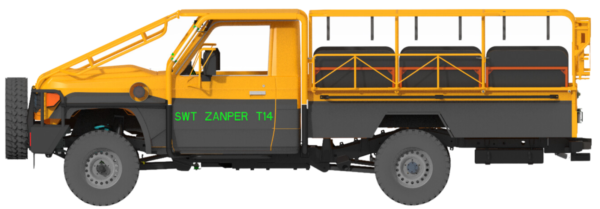
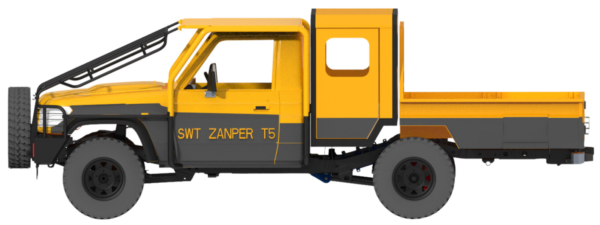
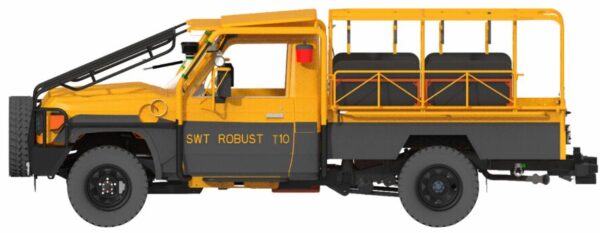
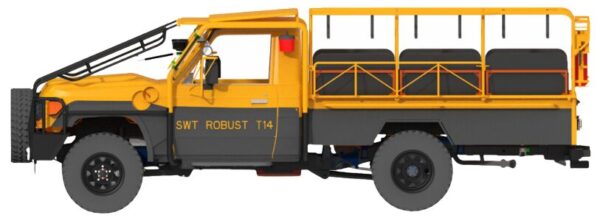
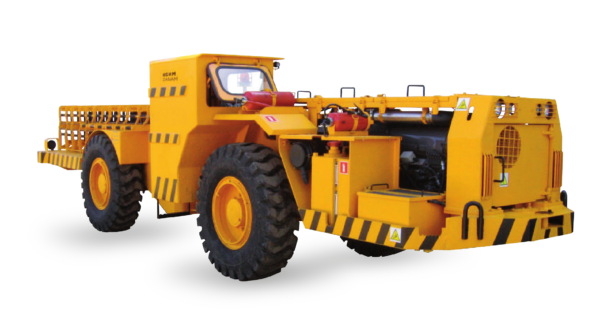
Self-propelled transport trucks are wheeled mining machines designed to transport underground personnel, materials, and equipment in the underground workings of metal ore mines. The KGHM ZANAM portfolio includes seven models across two design families: the battery-electric ZANPER and the combustion-engine ROBUST.
What are self-propelled transport trucks used for in a mine?
Underground, transport trucks perform two tasks: carrying crews to mining work areas and transporting selected materials and equipment. Efficient drive systems and high manoeuvrability make it possible to transport even a dozen or so workers safely along underground roads with varying profiles and limited clearance.
In day-to-day mine operations, self-propelled transport trucks are used for:
-
transporting crews to faces and work sites;
-
transporting auxiliary materials and, in the case of ROBUST vehicles, also blasting accessories;
-
delivering tools and spare parts to breakdown locations;
-
towing trailers and transportable equipment, for example a compressor;
-
assembly and overhaul work carried out directly in the workings.
Self-propelled trucks vs rail trucks in the KGHM ZANAM portfolio
The term “transport trucks” is sometimes used for both rail vehicles and wheeled vehicles. This category exclusively covers self-propelled wheeled trucks that move along underground roadways requiring no track infrastructure. This provides flexibility in routing, eliminates the need to build and maintain a trackway, and offers the ability to drive directly to the operations area.
The company’s expertise, however, is broader: KGHM ZANAM also manufactures rail transport trucks and special-purpose rail trucks, designed and built to custom orders for specific mining facilities.
ROBUST transport trucks: design and equipment
Trucks from the ROBUST family are based on the Toyota Land Cruiser and adapted to accommodate over a dozen personnel, as well as transport explosives and other materials. They are powered by diesel engines; in the current version complying with the STAGE V standard, they are all turbocharged.
Adapting the base vehicle to underground conditions involves a series of structural modifications:
-
an increased rear track width, improving vehicle stability (an option available with one type of rim);
-
suspension springs typical of off-road vehicles;
-
sealed wet brakes used alongside standard disc brakes (an option for the rear axle);
-
oil-resistant system wiring and hoses;
-
an electrical system and a programmable controller resistant to moisture, dust, and elevated temperatures.
Strengthening selected mechanical components and protecting sensitive elements results in an extended vehicle service life and lower operating costs throughout the machine’s life cycle.
ZANPER transport trucks: battery-electric drive
ZANPER is a family of fully electric transport trucks powered by a traction battery and driven by electric motors. The name is a portmanteau of the words ZANAM and ampere.
ZANPER trucks are offered in two design variants:
-
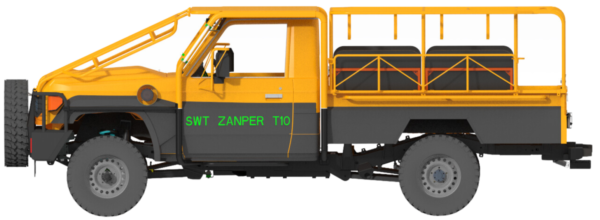
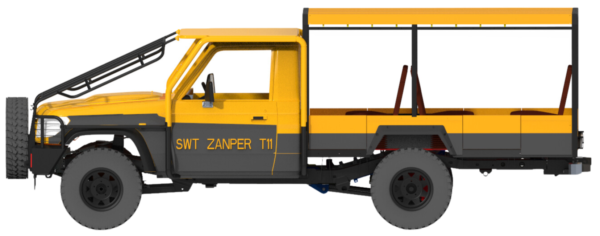
ZANPER T: vehicles created by adapting the Toyota Land Cruiser to underground conditions;
-
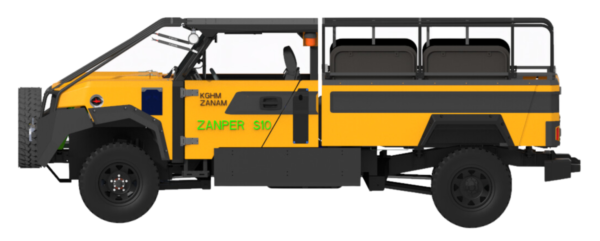
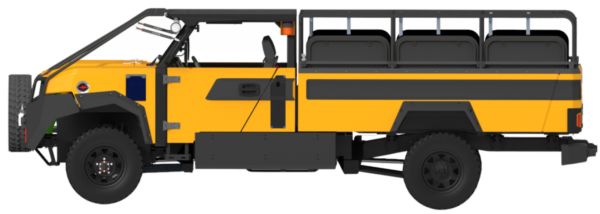
ZANPER S14 (also known as ZANPER 2.0): a vehicle designed and built entirely by KGHM ZANAM engineers on a proprietary chassis.
Battery operation translates directly into better underground working conditions: zero exhaust emissions in the working, a lower load on the ventilation system, reduced noise, and lower energy costs compared to diesel engines.
ZANPER trucks are not approved for transporting explosives; ROBUST trucks are designated for these tasks.
Service and assembly applications
Transport trucks can serve as a mobile repair workshop in the working and enable the delivery of components directly to the worksite. The ROBUST vehicle platform is used for this purpose. The exact equipment configuration of such vehicles is always agreed upon individually with the customer.
KGHM ZANAM transport truck models
The range includes seven models across two design families:
|
Model |
Family |
Purpose |
Number of personnel |
Drive |
|
SWT ZANPER T10 |
ZANPER |
Transport of personnel and materials |
10 (2+8) |
battery-electric |
|
SWT ZANPER T14 |
ZANPER |
Transport of personnel and materials |
14 (2+12) |
battery-electric |
|
SWT ZANPER T18 |
ZANPER |
Transport of personnel and materials |
18 (2+4+12) |
battery-electric |
|
SWT ZANPER S14 |
ZANPER |
Transport of personnel and materials |
14 (2+12) |
battery-electric |
|
ROBUST T10 |
ROBUST |
Transport of personnel and materials |
10 (2+8) |
diesel STAGE V |
|
ROBUST T14 |
ROBUST |
Transport of personnel and materials |
14 (2+12) |
diesel STAGE V |
|
ROBUST T18 |
ROBUST |
Transport of personnel and materials |
18 (2+4+12) |
diesel STAGE V |
What do the symbols in the model names mean?
-
T: a vehicle adapted from the Toyota Land Cruiser;
-
S: a vehicle on a chassis designed by KGHM ZANAM (ZANPER S14 / ZANPER 2.0);
-
number: the number of personnel accommodated, including the operator; for example, the T14 is a 14-person vehicle with a 2+12 seating arrangement.
Transport trucks with electric drives
The ZANPER electric-powered mining transport truck was developed as part of a project co-financed by the European Union. The project has been completed, and the vehicle is now available as a standard production model.
Machine specifications:
-
capacity of 14 personnel (2+12);
-
60 (90) kW electric motor;
-
90 kWh NMC battery;
-
maximum range of up to 200 km.
Transport trucks vs other mining machines
Transport trucks constitute one of the six groups of mining machines in the company’s portfolio. They differ from the others in their function within the production cycle:
-
load haul dump loaders are responsible for hauling run-of-mine material from the production face to the transfer point;
-
auxiliary trucks handle production support activities, such as scaling or spraying the production face;
-
explosives charging trucks are used for blasting operations;
-
drilling and bolting trucks perform blasthole drilling and roof bolting;
-
mining loaders are responsible for loading run-of-mine material.
Service and spare parts
The KGHM ZANAM service team provides support for:
-
periodic inspections of self-propelled transport trucks;
-
warranty and post-warranty repairs;
-
vehicle diagnostics;
-
major overhauls.
Response times. KGHM ZANAM is present in all mining areas of KGHM Polska Miedź S.A. and provides round-the-clock machine service 7 days a week. Service requests are handled on an ongoing basis and categorised by priority.
Spare parts availability. The company has its own spare parts warehouses underground in KGHM Polska Miedź S.A. mines, as well as a central service warehouse at the company’s headquarters, which allows it to offer zero waiting time for key components.
Maintenance contracts. KGHM ZANAM ensures constant technical supervision, inspection scheduling, and fixed hourly rates throughout the duration of the contract.
Operator training covers the safe operation and use, the design of the manufactured machines and vehicles, as well as daily maintenance and initial fault diagnostics.
Explore the scope of technical services
Request a quote
The selection of a transport truck depends on the geometry of the workings, the scope of transport operations, and the operational requirements of the mining facility.
Frequently asked questions
How many people can a self-propelled transport truck carry?
Self-propelled transport trucks are designed to carry a dozen or so workers to mining work areas. The exact number of seats depends on the model: from 10 people (2+8) in the T10 versions up to 18 people (2+4+12) in the T18 versions.
What is the difference between ZANPER and ROBUST vehicles?
ZANPER vehicles are battery-electric vehicles powered by electric motors. ROBUST trucks are diesel vehicles with turbocharged diesel engines complying with the STAGE V standard. ROBUST trucks are approved for transporting explosives, whereas ZANPER trucks are not.
How does a transport truck differ from a load haul dump loader?
A transport truck carries people, materials, and equipment, while a load haul dump loader is used to haul run-of-mine material from the production face to the transfer point. These are two distinct functions in the mine’s production cycle, carried out by machines with different designs and purposes.
Can self-propelled transport trucks operate in hard coal mines?
No. KGHM ZANAM transport trucks are designed for underground non-gassy workings in mines extracting metal ores and minerals other than hard coal.
Can a transport truck be customised to individual needs?
Yes. The vehicle configuration is determined individually with the customer, based on the scope of transport operations and the conditions prevailing in the workings of the specific mining facility.
Does KGHM ZANAM manufacture rail vehicles?
Yes. In addition to self-propelled wheeled trucks, the company manufactures rail transport trucks and special-purpose rail trucks built to custom orders.
What base vehicle are ROBUST trucks built on?
ROBUST trucks are based on the Toyota Land Cruiser, adapted for underground operations by modifying the drive system, suspension, braking system, lighting, and electrical system.
What base vehicle are ZANPER trucks built on?
Depending on the version, ZANPER trucks are either built on a proprietary KGHM ZANAM chassis design (ZANPER S14) or based on an adapted Toyota Land Cruiser (ZANPER T) modified for underground operations by upgrading the drive system, suspension, braking system, lighting, and electrical system.